
Attention: You are using an outdated browser, device or you do not have the latest version of JavaScript downloaded and so this website may not work as expected. Please download the latest software or switch device to avoid further issues.
| 1 Oct 2025 | |
| Research News |
A new geosynthetics reference manual created by the IGS and drafted by some of the industry's top practitioners launched today.
The IGS Geosynthetics Handbook is a one-stop technical reference guide suitable for all levels of experience in geosynthetics. The printed digest offers a concise yet comprehensive summary of the fundamental applications of geosynthetics and is an essential reference guide for student, instructor or civil engineering professional.
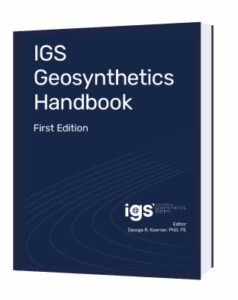
Edited by industry guru Dr. George R. Koerner, the compendium is a 'living document' which will be continually updated to incorporate industry developments and latest research.
Dr. Koerner said he had "great pride and satisfaction" in finally seeing the Handbook in print and thanked all those involved in bringing the project to fruition, including support from the IGS Foundation and IGS Premium Corporate Members.
"Geosynthetics have proven to be among the most versatile and cost-effective construction materials on the face of this earth. Their use has expanded rapidly into nearly all areas of civil engineering. However, while the use of geosynthetics is widespread, their use should be considered just beginning," he said.
"This handbook introduces geosynthetics from the perspective of practice rather than design and is intended to serve as a general reference in the field for those who are constructing with geosynthetics, to enable effective learning, problem-solving and inform decision-makers."
The guide is divided into eight chapters, with originating authors and topics as follows:
Dr. Koerner said: "We leveraged our network and connections to assemble a great group of originating authors who are prominent figures in their respective relevant fields. Hopefully this is the first edition of many IGS Geosynthetic Handbooks – as the geosynthetic industry evolves this document should update with it.
"Information in the Handbook will also augment the technical curriculum of future training courses."
IGS President Samuel Allen said: "Application-driven and accessible to the beginner as well as the expert, this inaugural edition of the IGS Geosynthetics Handbook will now exist alongside other already established material references (e.g lumber and steel), establishing geosynthetics as a mandatory construction material for all engineered infrastructure projects.
"Our Handbook also demonstrates the IGS's continued commitment to geosynthetics education, providing value to our members, their customers and the wider public. Many dedicated hours were contributed by the IGS Technical Committees and the IGS Education Committee. Their expertise is represented in this IGS publication."
Buy your copy of the IGS Geosynthetics Handbook, priced $150 for IGS members and $200 for non-members, by clicking this link. We are keen to support Chapters to make good use of the book for your outreach, in support of events and courses. For this reason, we are offering IGS Chapters the opportunity to order bulk shipments of 30 copies or more at a discounted price of US$75 per copy, contact igssec@geosyntheticssociety.org to learn more.
Digital and translated versions of the IGS Geosynthetics Handbook may be developed in the future. Further recent education initiatives include the IGS Environmental Sustainability Calculator and the upcoming IGS Professional Development Courses. The IGS is also committed to raising its profile and that of its members at global expos, most recently attending ESS 2025 in Birmingham, UK.
Take a look at this short video with Handbook contributor Kent von Maubeuge on the document's development.


